 Precision Store
 Buy On Amazon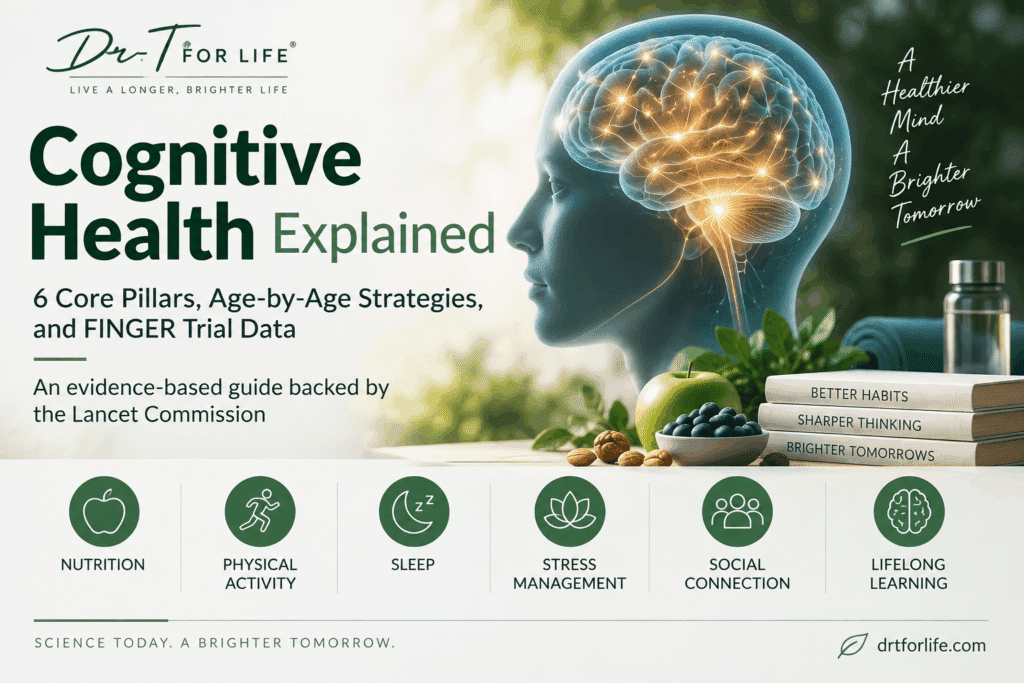
This guide covers 6 core pillars of cognitive health, 7 essential cognitive skills, and 14 modifiable risk factors identified by the 2024 Lancet Commission. It includes age-specific strategies from the 30s through the 70s, backed by evidence from clinical trials like FINGER. The content is relevant to professionals looking to support focus as well as older adults interested in protecting long-term cognitive health. Readers get fact-based interventions, separated clearly from common myths.
What Is Cognitive Health?
Cognitive health is the brain’s capacity to think, learn, remember, judge, and reason effectively. It enables people to manage daily tasks, such as paying bills, following directions, and keeping appointments.
Cognitive health differs from mental health. Cognitive health governs how the brain processes information. Mental health governs mood, emotional regulation, and psychiatric conditions, such as depression, anxiety, and bipolar disorder. The two interact closely. A 2025 umbrella review found midlife depression raises all-cause dementia risk by 56% (HR 1.56).
Cognitive health is also related to brain health, a broader term covering the brain’s physical structure and blood vessels. Cognitive health specifically measures how well the brain performs its thinking functions.
Cognitive health relies on 4 key brain functions:
- Memory — encoding, storing, and retrieving information in the hippocampus, including episodic memory (personal events), semantic memory (facts), and working memory (short-term tasks)
- Focus — sustaining attention in the brain’s frontoparietal network while filtering out distractions, such as background noise or notifications
- Processing speed — decoding and responding to information quickly via central neural pathways, affecting tasks like driving or following conversation
- Executive function — planning, decision-making, and impulse control, governed by the prefrontal cortex
These four functions work together. A decline in one affects the others. Slower processing speed frequently precedes noticeable memory or judgment changes.
Normal Aging vs. Warning Signs — and What to Do Next
Normal aging causes occasional forgetfulness; warning signs involve persistent, progressive decline that disrupts daily life. Distinguishing between the two determines whether a memory change needs monitoring or a medical evaluation.
What’s Normal Age-Related Forgetfulness
Normal forgetfulness is brief, occasional, and doesn’t affect independence. Common examples include misplacing keys, briefly forgetting a name, or pausing mid-sentence for a word. People with normal age-related changes still manage instrumental activities of daily living (IADLs) independently, such as paying bills, planning trips, and taking medications correctly. The core detail of an event stays intact, even when minor specifics fade.
Signs That Need Medical Attention
Certain patterns signal a need for clinical evaluation, not just normal aging. Five red-flag symptoms warrant a doctor’s visit: repeating the same question within minutes, getting lost in familiar places, struggling with multi-step tasks like cooking a recipe, showing poor financial judgment, and losing words mid-conversation. Any one of these, if persistent, justifies a medical appointment.
MCI vs. Dementia vs. Alzheimer’s
These three terms describe different points on a cognitive decline spectrum, not interchangeable labels. The table below compares diagnostic criteria and outcomes.
| Category | Domain Impairment | Daily Independence | Progression |
| Normal Aging | Minor recall delays | Fully independent | Stable |
| MCI | Deficits in 1+ domain | Independent; complex tasks take more effort | The rate of progression from mild cognitive impairment to dementia varies by population, underlying cause, and clinical setting. Some people remain stable, and some improve. |
| Dementia | Multiple domains affected | Major impairment | Dementia is often progressive, but its course depends on the underlying cause. Clinical assessment is important because some contributors to cognitive impairment may be treatable or reversible. |
| Alzheimer’s Disease | Memory impairment is a common early presentation, but Alzheimer’s disease can also begin with language, visual-processing or executive-function changes. | Progressive loss | 60–80% of all dementia cases |
How Cognitive Testing Works
Cognitive testing ranges from informal home checks to formal clinical diagnosis. At-home apps and questionnaires offer a rough baseline but can’t replace clinical evaluation. In clinical settings, doctors commonly use the Montreal Cognitive Assessment (MoCA). The MoCA is often more sensitive than the MMSE for detecting mild cognitive impairment, particularly executive and visuospatial changes, although performance varies by population and cutoff score. Both tools remain in clinical use.
How to Talk to a Loved One About Memory Concerns
Effective conversations focus on specific behaviors, not diagnostic labels. Describe concrete examples, such as a missed bill of payment or a repeated question, rather than saying “your memory is failing.” Frame a doctor’s visit as routine health maintenance, not a crisis. This visit identifies treatable causes, including vitamin B12 deficiency, thyroid problems, and sleep apnea. A calm, fact-based approach reduces defensiveness and increases the chance of follow-through.
The Core Pillars of Cognitive Health
Cognitive health depends on 6 core pillars: physical exercise, nutrition, sleep, mental stimulation, social connection, and stress management. Each pillar acts on the brain through a distinct biological mechanism.
Physical Exercise
Physical activity may support neuroplasticity, cerebral blood flow, and cognitive resilience. Routine physical activity has been associated with a lower risk of dementia in observational research. Adults should aim for at least 150 minutes of moderate aerobic activity weekly.
Nutrition (Mediterranean & MIND Diet)
The MIND diet supports brain health by combining Mediterranean and DASH eating patterns. It emphasizes green leafy vegetables, such as spinach and kale, along with berries, nuts, and extra virgin olive oil. Fatty fish, including salmon and sardines, provide omega-3 fatty acids that may support the brain and cardiovascular health. The diet limits red meat, butter, cheese, and refined sugar. In observational research, strong adherence to the MIND diet was associated with up to a 53% lower incidence of Alzheimer’s disease. This does not prove that the diet alone prevents Alzheimer’s disease.
Quality Sleep
Quality sleep supports memory consolidation, attention, and overall cognitive performance. Consistently poor or insufficient sleep has been associated with poorer cognitive outcomes and a higher risk of cognitive decline. Nutritional support may also be relevant to sleep and nervous-system health. Explore Mag Wonders™ for more information.Most adults should aim for seven to nine hours of sleep per night while addressing persistent problems such as insomnia, snoring or suspected sleep apnea with a qualified healthcare professional.
Mental Stimulation
Challenging mental activities build cognitive reserve, a buffer against age-related decline. Learning a new skill, such as a language, musical instrument, or complex hobby, creates new neural connections. Reading, puzzles, and strategy games also stimulate distinct brain regions, including the prefrontal cortex and hippocampus. Novel, difficult tasks provide more benefit than repetitive, familiar ones. Continuous intellectual challenges help the brain function normally despite underlying structural changes.
Social Connection
Strong social ties may support cognitive function. Conversations require rapid processing of language, tone, and facial expressions simultaneously. Social isolation is one of the modifiable risk factors identified by the 2024 Lancet Commission. Population-level estimates suggest that reducing isolation could contribute to dementia-risk reduction. Chronic stress and prolonged exposure to elevated stress hormones have been associated with changes in memory and cognitive function. Regular interaction with family, friends, and community groups support long-term brain health.
Stress & Chronic Condition Management
Chronic stress and poorly managed health conditions may negatively affect cognitive and vascular health over time. Chronic stress and prolonged exposure to elevated stress hormones have been associated with changes in memory and cognitive function.For readers interested in nutritional support related to stress and focus, explore Moods™. Uncontrolled conditions, such as hypertension, type 2 diabetes, and high cholesterol, also damage cerebral blood vessels, including small arteries and capillaries. These conditions increase the risk of silent strokes and reduce blood flow over time. Managing blood pressure, blood sugar, and cholesterol during midlife may help support long-term cognitive health. Stress-reduction techniques, including meditation, deep breathing, and regular exercise, lower cortisol levels effectively.
Cognitive Health by Age
Cognitive health priorities shift across 3 life stages: the 30s–40s, 50s–60s, and 70s and beyond. Each stage carries distinct, evidence-based priorities.
30s–40s: Building the Foundation
This stage focuses on maximizing cognitive reserve before age-related risk factors accumulate. Low educational attainment accounts for approximately 5% of global dementia risk. Early learning builds lasting neural network redundancy. Protective gear, such as helmets and seatbelts, prevent traumatic brain injury (TBI), which contributes to another 3% risk. Physical inactivity adds 2% of attributable risk. Excessive alcohol intake adds 1% more; avoiding excessive alcohol intake is part of a brain-healthy lifestyle. The Lancet Commission identifies consumption of more than 21 units per week as a modifiable dementia risk factor.
50s–60s: Managing Risk
Midlife carries the greatest attributable impact on future dementia risk of any life stage. High LDL cholesterol accounts for approximately 7% of global dementia risk. Each 1 mmol/L rise in LDL was associated with an 8% increase in dementia incidence. Age-related hearing loss contributes to another 7% risk. Addressing hearing loss, including appropriately fitted hearing aids when indicated, may help support communication, social engagement and cognitive health. Depression adds 3% more, while diabetes and hypertension each contribute roughly 2%.
70s+: Maintenance and Staying Sharp
This stage focuses on sustaining independence and correcting sensory loss. Uncorrected vision loss contributes to approximately 2% of dementia risk. Lost sensory input accelerates cognitive decline in the aging brain. Structured physical exercise may help reduce the risk of frailty, muscle loss, and gait instability. Social isolation accounts for approximately 5% of risk. Continued social participation may help support cognitive and social health. Air pollution adds another 3%, and smoking cessation addresses a further 2% of late-life risk.
Common Myths and Mistakes
Cognitive health misinformation spreads through aggressive marketing and unverified claims. Separating evidence from myth prevents wasted effort and money.
Do Brain Games Really Work?
Commercial brain-training apps produce narrow, game-specific improvement, not broad cognitive gains. This effect, called “near transfer,” means players get better at the trained task only. Skills rarely transfer to untrained domains, such as memory, planning, or problem-solving. Multi-domain approaches, combining exercise, nutrition, and social engagement, outperform isolated brain-training software. Compared with the control group, the intervention group showed a 25% greater improvement in the overall cognitive score .
Do Supplements and Nootropics Help?
Most over-the-counter memory supplements and nootropics lack scientific evidence, despite bold marketing claims. This includes ginkgo biloba, piracetam, and caffeine-L-theanine blends, commonly sold as focus enhancers. Prevagen, a supplement containing apoaequorin, faced federal action from the FTC and New York’s Attorney General. A 2024 court injunction barred the manufacturer from claiming the product improves memory. Standard daily multivitamins show different results, however. The COSMOS trial tested this directly. Researchers at Wake Forest, Brigham and Women’s Hospital, and Columbia University ran the study. They found that daily multivitamin use produced modest improvements in some measures of cognition among older adults. For readers interested in exploring a targeted supplement for memory and focus support, see [Brain Tune™].
“It’s Too Late to Improve” — True or False?
This statement is false. Neuroplasticity, the brain’s ability to reorganize itself, persists throughout life. The FINGER trial enrolled adults aged 60 to 77 at increased risk of decline. After two years, the intervention group showed a 25% greater improvement in overall cognition than the control group. Larger relative between group differences were reported in executive function and processing speed. These gains occurred even in participants carrying the APOE ε4 gene variant, a known genetic risk factor.
Advanced Concepts: How the Brain Protects Itself
The brain protects itself through cognitive reserve, neuroplasticity, and evidence from clinical research. Together, they explain why people with identical brain damage show different outcomes.
Cognitive Reserve
Cognitive reserve is the brain’s ability to adapt despite physical damage or aging. Developed by Dr. Yaakov Stern, this framework explains why some people tolerate more brain pathology than others. It operates through two mechanisms: neural reserve and neural compensation. Neural reserve uses existing brain networks more efficiently, delaying noticeable symptoms. Neural compensation recruits alternative brain regions, such as the parietal or temporal lobes, when primary circuits are damaged. Education, occupational complexity, and lifelong learning all build cognitive reserve over time.
Neuroplasticity
Neuroplasticity refers to the brain’s capacity to adapt and reorganize its connections throughout life. Physical activity, cognitive challenges, and environmental enrichment may support this adaptability. The extent and clinical significance of adult neurogenesis in humans remain in areas of active research.
What Research (Like the FINGER Study) Shows
The FINGER trial provides evidence that a structured, multidomain lifestyle intervention can support cognitive performance in older adults at increased risk of cognitive decline. The FINGER trial enrolled 1,260 older adults aged 60 to 77 at risk of decline. Participants followed a combined program, including diet counseling, exercise, cognitive training, and social engagement. After two years, the intervention group showed a 25% greater improvement in the overall cognitive score compared with the control group. The 2024 Lancet Commission builds on this evidence. It identified 14 modifiable risk factors, such as hearing loss, smoking, and physical inactivity. Together, these factors account for 45% of dementia cases worldwide.
Frequently Asked Questions
What are the 7 cognitive skills?
The seven core cognitive skills are attention, memory, processing speed, executive function, language, perception, and visuospatial processing. These skills govern how the brain focuses, remembers, and responds to information. Together, they support daily tasks, such as driving, conversing, and managing finances.
Can diet help reduce the risk of cognitive decline?
A healthy dietary pattern may contribute to a lower risk of cognitive decline and dementia, but it cannot guarantee prevention. Observational evidence has linked stronger adherence to MIND dietary patterns with better cognitive outcomes.
Is it too late to improve cognitive health at any age?
No, it is never too late. Neuroplasticity persists throughout life, even in older ages. Compared with the control group, the intervention group showed a 25% greater improvement in the overall cognitive score. Executive function and processing speed showed the largest gains.


Leave a Reply